Hiring a Founding SDR? Build the Sales System First
Oct 19, 2026
By Luka Zurabishvili

A founding SDR is the first sales development rep a company hires: the person who takes prospecting, outreach and meeting booking off the founder’s plate. Most founders make the hire hoping it will fix pipeline. It rarely does on its own, because what actually produces pipeline is the system the SDR works inside. At most early-stage companies, that system lives in the founder’s head, if it exists anywhere at all.
When the system is missing, a founding SDR spends their first months guessing. They guess who to call, what to say, whether a meeting counts and how to answer the question they were never briefed on. Some guesses land. Most turn into messages to the founder, which is exactly the work the SDR was hired to take away.
That is the short version of this article. A founding SDR runs a sales system. They are not the right person to invent it.
What Founders Expect From a Founding SDR
Founding SDR job ads set the bar high. One we read while researching this piece wants the hire to work directly with the founders to shape messaging, outreach strategy and the first sales playbooks. Another asks the SDR to develop the ideal customer profile, the messaging, the pitch and the email strategy, and to own pipeline generation across every channel.
That is three jobs in one title. There is a strategist, who decides who the company sells to and why they should care. There is a researcher, who finds those people and their contact details. And there is a caller, who gets them on the phone and books the meeting. Founders write all three into a single job description, hire someone with a year or two of outbound experience and expect the pipeline problem to go away.
The assumption underneath is that the SDR will figure it out. Occasionally a very good one does. More often, the SDR ends up doing the work of a sales leader and a list builder while being judged on meetings booked, and the meetings do not come.
Why the System Cannot Be Built From the Phone
An SDR learns from the market one conversation at a time, and a rejection on its own says very little. A “not interested” could mean the company was never a fit, the contact was the wrong person, the message missed, the timing was off or the offer was not strong enough. Without a tested ICP and a message that has worked at least once, every one of those variables is moving at the same time. The SDR cannot tell which one is broken, so the learning stays vague.
Even when the SDR does spot a pattern, they rarely have the authority to act on it. A junior hire can notice that one segment never answers. They usually cannot drop that segment, change the offer or rework the positioning without the founder. So the insight travels back up the chain, waits for a gap in the founder’s week and comes back days later, if it comes back at all.
The benchmarks point the same way. The Bridge Group’s 2025 SDR research puts average SDR ramp time at 3.0 months across 351 B2B companies, most of them SaaS businesses with established sales development teams. Those companies have managers, onboarding and playbooks already in place. A founding SDR starts with none of that, so there is little reason to expect them to ramp faster than the average.
None of this means the founding SDR should be a script reader. We touched on this in What Founders Get Wrong About Building a B2B Sales Pipeline: the first seller needs curiosity and comfort with ambiguity. Curiosity is what makes a feedback loop useful. It is not a substitute for having one.
What the System Looks Like Before Anyone Dials
Process first does not mean a 60-page playbook. It means the small set of decisions that let an SDR work a full day without needing the founder. In our experience, the system comes down to nine pieces.
Piece of the system | What it looks like when it exists | What happens when it is missing |
A tested ICP | The SDR knows which companies and roles to contact and why those ones. At least one round of outreach has shown that the segment responds. | The SDR calls whoever is on the list, and the results cannot be read. |
A list, or a way to build one | A ready list for the first weeks, or a written sourcing method with the tools and filters to use. | Half the week goes on research instead of conversations. |
Messaging that has worked | Openers, angles and emails that have produced replies or meetings before, even if the founder was the one sending them. Where nothing is proven yet, a plan for which angles get tested first. | Every call is a fresh experiment. |
Sales qualified lead criteria | Written criteria for when a prospect is ready for a sales conversation: the account fits, the problem is relevant, there is a reason to talk now and the contact can influence the decision. The SDR and whoever takes the meetings agree them before the first booking. | The SDR books anyone who says yes, and sales stops trusting the calendar. |
Who takes the meetings | A named person runs each booked call and knows why it qualified. | Meetings get booked that nobody is free to take, or that nobody prepares for. |
A daily feedback loop | A short daily review of what prospects said, which objections came up and what changes tomorrow. | The SDR learns alone, and the same mistakes repeat for weeks. |
CRM hygiene and criteria | Stages, required fields and the rules for moving a record are written down. | The CRM fills with activity nobody can analyze. |
Rules and escalation | What the SDR can decide alone, what they can promise and when someone else steps in. | Every unusual question becomes a message to the founder. |
A product brief | A plain-language page on what the product does, who it is for, pricing boundaries and the questions prospects usually ask. | The SDR improvises answers or avoids the questions. |
None of these pieces has to be perfect. Each one has to exist, be written down and be owned by someone other than the SDR. Most of them already live in the founder’s head, and the real work is getting them out of it.
The feedback loop is the easiest piece to skip, because it feels like overhead. It is also the one that pays back fastest. A founding SDR hears more objections in a week than most founders hear in a month. When someone reviews those conversations every day, the messaging sharpens within days. When nobody does, the learning sits in the SDR’s personal notes, and the company only finds out what the market was saying when the SDR leaves.
Qualification criteria matter for a similar reason. If nobody has agreed what makes a sales qualified lead, the SDR optimizes for the number on their dashboard, and the founder or AE ends up sitting through calls that were never going anywhere. The standard has to be agreed before the handoff, not argued about afterwards. And if the line between the process and the playbook is fuzzy, Sales Playbook vs Sales Process covers where each one starts and stops.


The Escalation Test
The quickest way to tell whether the system is in place is to look at what the SDR escalates.
Some questions should always go up the chain. A large prospect asking for custom terms, a complaint, anything with legal weight. But when the SDR has to ask whether a 20-person company is in the ICP, whether they are allowed to mention pricing, who is taking Tuesday’s demo or what to say when a prospect compares the product to a competitor, those are questions the system should already answer.
If an SDR needs to escalate everything, the company was not ready for one yet. That is not a verdict on the person. It shows the decisions were never made, so the SDR is borrowing the founder’s judgment one message at a time. The founder ends up managing a new hire on top of selling, which is the opposite of the reason the role was opened.
It is the same pattern behind sign six in Founder-Led Sales: 7 Signs It Is Time to Build a Sales Team: a new hire without a defined system becomes one more person for the founder to manage.
Same Seat, Different System: A SaaS Example
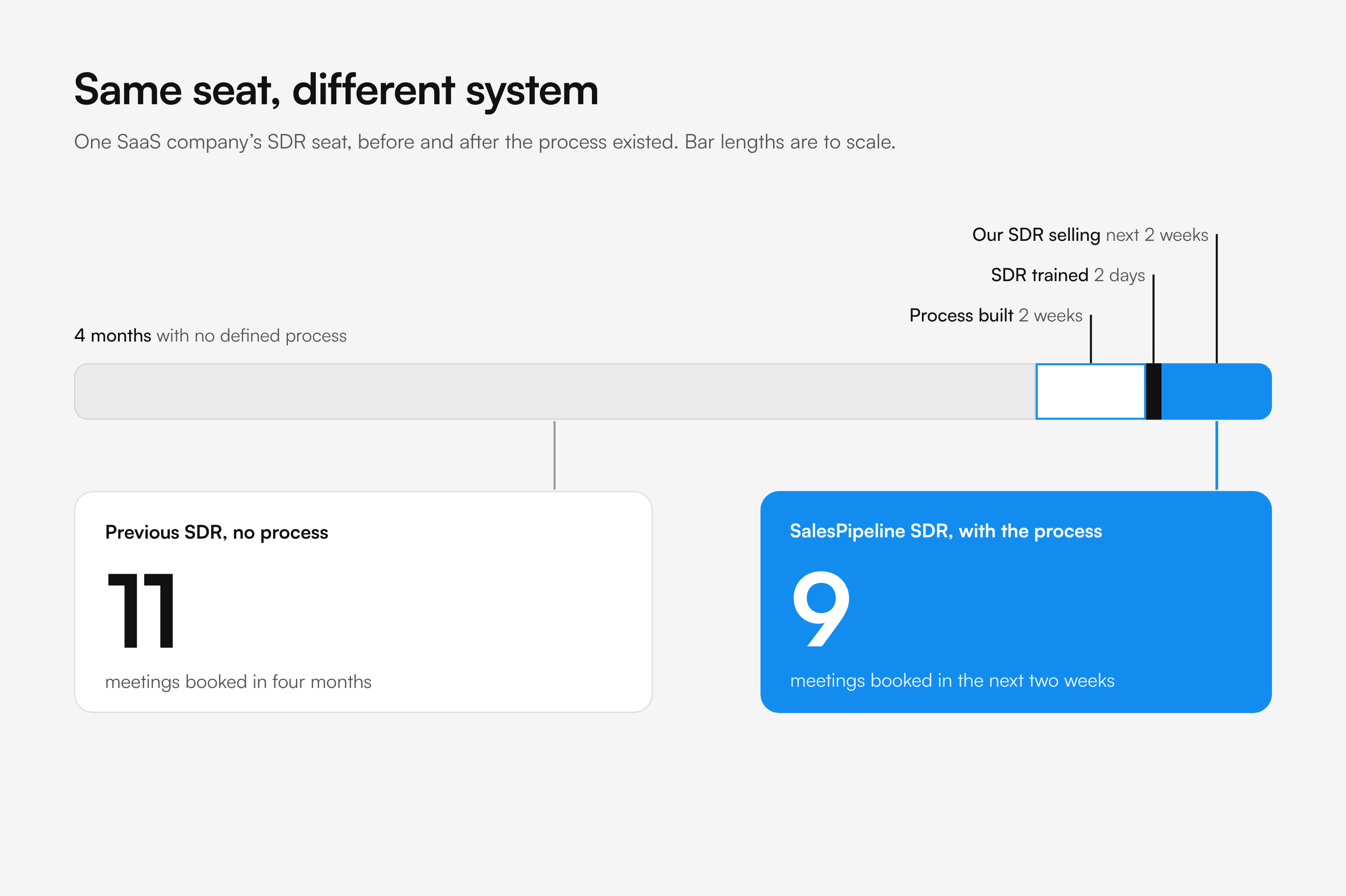
Our most recent example is a B2B SaaS company that had already hired an SDR before we started working together. There was no defined sales process and no systems around the role. Over four months, the SDR had booked 11 meetings.
The company parted ways with that SDR, and we brought in one of our own. We spent two weeks building the process, then two days training our SDR on it. In the two weeks after the training, he booked 9 meetings.
Same company, same product, same market, same seat. The difference was that our SDR had a process to run from day one instead of one to invent. A different person was in the seat, so the comparison is not perfect, and two weeks is a short window. We are not presenting 9 meetings as a steady fortnightly rate. What the numbers do show is how much of the result sits in the system rather than in the hire.

The order was the same when we started from zero with a pre-revenue AI startup that had no ICP, no outbound motion and no sales hire. The first week went on a narrow ICP and a list. In week two, one SDR started cold calling and messaging on LinkedIn, with daily feedback on the messaging. An AE joined to close in week three, and the company signed its first client 21 days after starting from no sales process.
Founding SDR or Founding Account Executive?
Founding account executive is the other common first sales hire, and it is searched far more often than founding SDR. The two roles solve different problems. An SDR creates conversations. An AE turns conversations into revenue.
If the founder still closes well and simply has no time to prospect, an SDR filling the founder’s calendar is the logical first hire. If the founder already has more conversations than they can close, the bottleneck sits further down the funnel, and an AE is the better fit. Either way the system still comes first. A founding AE without a qualification standard and a defined sales process hits the same wall, only later in the funnel and at a higher salary.
Whichever role comes first, it helps to know what a sales hire really costs before the job ad goes live.
Who Builds the System
Someone has to take what is in the founder’s head and turn it into something an SDR can run. Usually that falls to the founder, and the honest problem is time. Most founders hire an SDR precisely because they have none left.
The alternatives are bringing in help to build the process, or bringing in a team that arrives with one. Sales pipeline consulting covers the first: defining the ICP, pipeline stages, qualification rules and review rhythm before more people are added. Our outsourced sales team covers the second: SDRs hired, trained and managed by SalesPipeline, running a playbook written for your company inside your own CRM.
Hiring your own founding SDR can still be the right call. It simply works far better when the system is ready on their first day, rather than something they are expected to build in their first quarter.
Founding SDR Readiness Check
These are the questions we would want answered before a founding SDR job ad goes live. If most of the honest answers sit in the right-hand column, the hire is early.
Question | Ready | Not yet |
Who exactly are we selling to? | ICP written down and tested with real outreach | “Companies that need us” |
Where do the names come from? | A list for the first month, or a written sourcing method | “The SDR will find them” |
What do we say? | Messaging that has produced replies or meetings | “We will work it out on calls” |
What makes a lead sales qualified? | Written SQL criteria agreed by the SDR and whoever takes the meetings | “We will know it when we see it” |
Who takes the meetings? | A named owner who knows why each meeting qualified | “Whoever is free” |
How does feedback flow? | A daily review slot with a named person | Ad hoc chat messages |
What goes in the CRM? | Stages, required fields and rules for moving records | “Log everything” |
What can the SDR decide alone? | Written rules and clear escalation triggers | “Ask the founder” |
Does the SDR understand the product? | A one-page product brief with answers to common questions | “Read the website” |
The Hire Comes Second
A founding SDR can be one of the best hires an early B2B company makes. Most of that value comes from what the SDR is handed on day one: a tested market, a message that has worked, someone to take the meetings and a daily conversation about what prospects are saying. Without those, even a strong hire spends months rebuilding what the founder already knows.
If you want a founding SDR motion without waiting a quarter for it to come together, talk to us about your pipeline. With our outsourced sales team, the playbook, the training and the management come with the SDR.
Sign Up to Our Newsletter
Subscribe to receive updates and automation tips straight to your inbox.
Related Articles
AI automation insights to help your business move faster and smarter.

