What Is a Sales Qualified Lead (SQL)
Sep 30, 2026
By Luka Zurabishvili

A sales qualified lead is a person or account that sales has accepted for active pursuit because it meets the company’s agreed standards for fit and buying intent. The important word is accepted. An SQL is not created by a form submission alone, and it is not whatever marketing decides to send across the line.
That distinction matters because someone downloading a guide is usually trying to solve their own problem. They may be useful to nurture. They may fit your ideal customer profile. But unless the download is paired with stronger intent, they have not necessarily asked for a sales conversation.
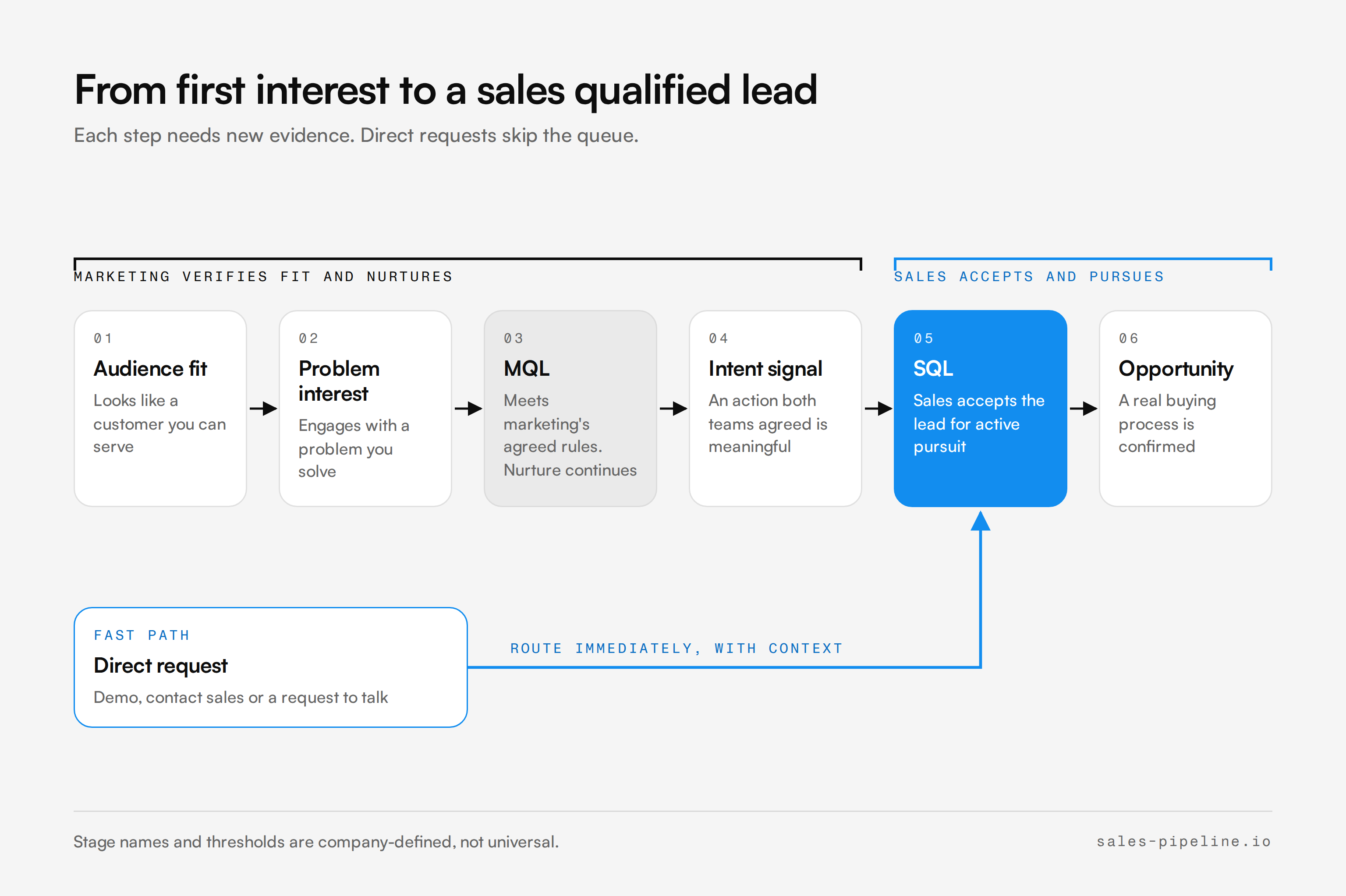
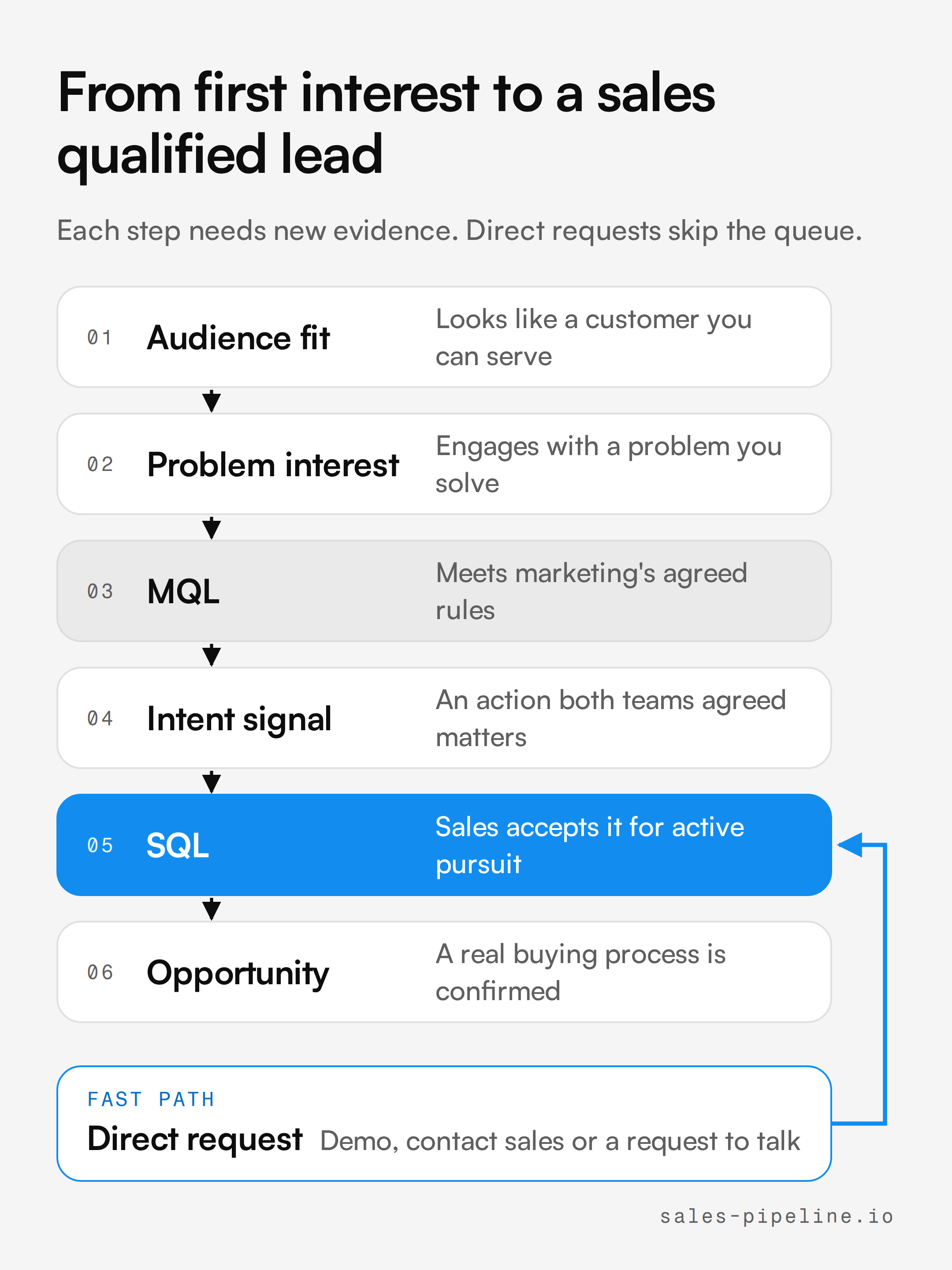
A useful SQL definition protects sales time without discarding future buyers. It gives direct requests a fast path, keeps early-stage contacts in nurture and makes the handoff between marketing and sales measurable.
What a Sales Qualified Lead Means
Most definitions of an SQL include two ideas: the lead resembles a customer the business can serve, and there is enough evidence of purchase intent to justify direct sales attention. The exact threshold should vary by sales motion, deal size, market and buying cycle.
For a product-led business, product usage may provide the decisive signal. For a consulting business, a request to discuss a defined problem may matter more. For an account-based team, account fit and activity from several stakeholders may be stronger than one person’s content download.
The label is useful only when it changes what happens next. Once a lead becomes an SQL, a named sales owner should know why the lead qualified, what signal triggered the handoff and what action to take. If sales still has to reconstruct the entire story, the stage is only a CRM label.
Why a Lead Magnet Download Is Not an SQL
The common failure pattern looks simple:
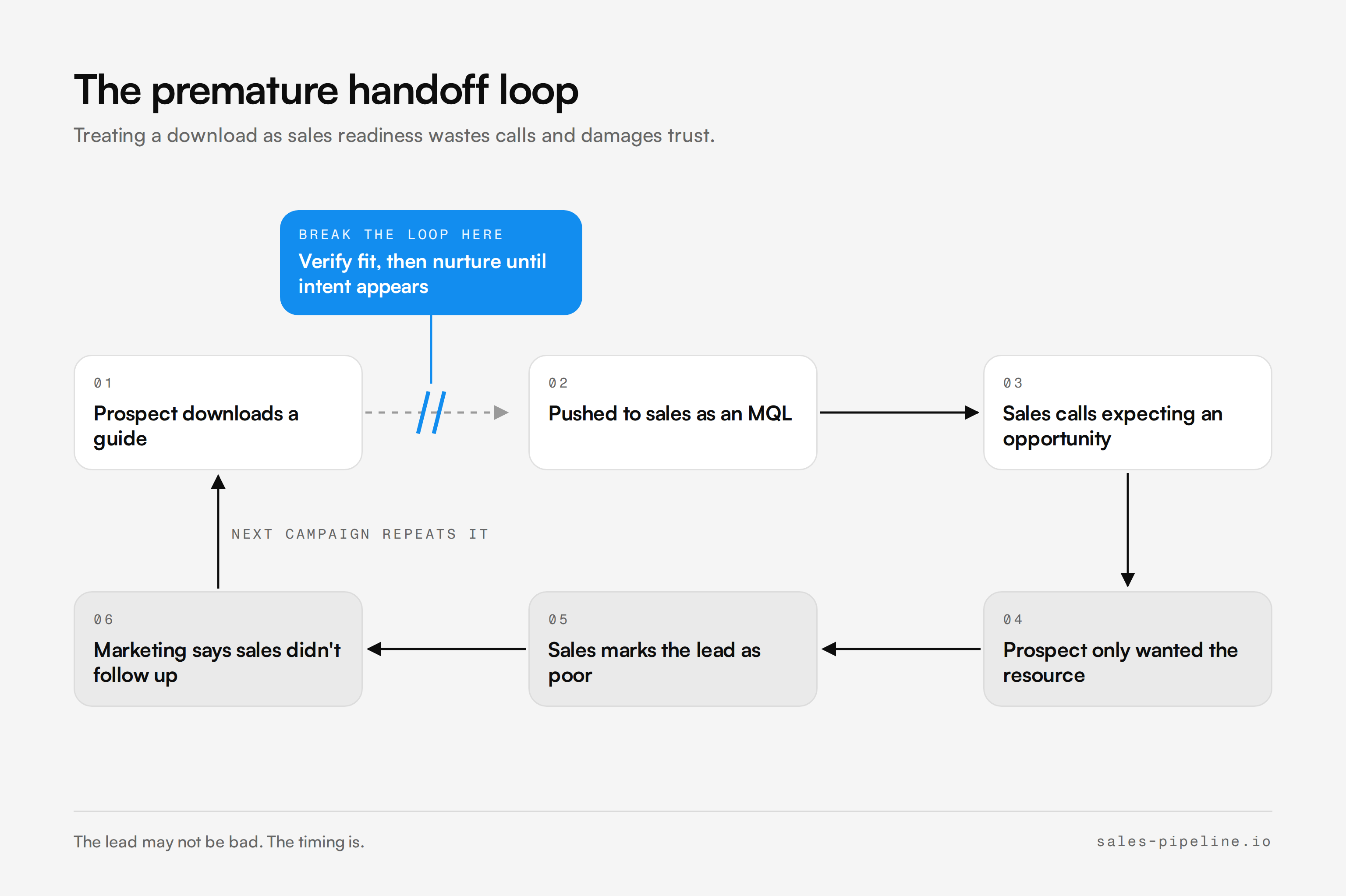
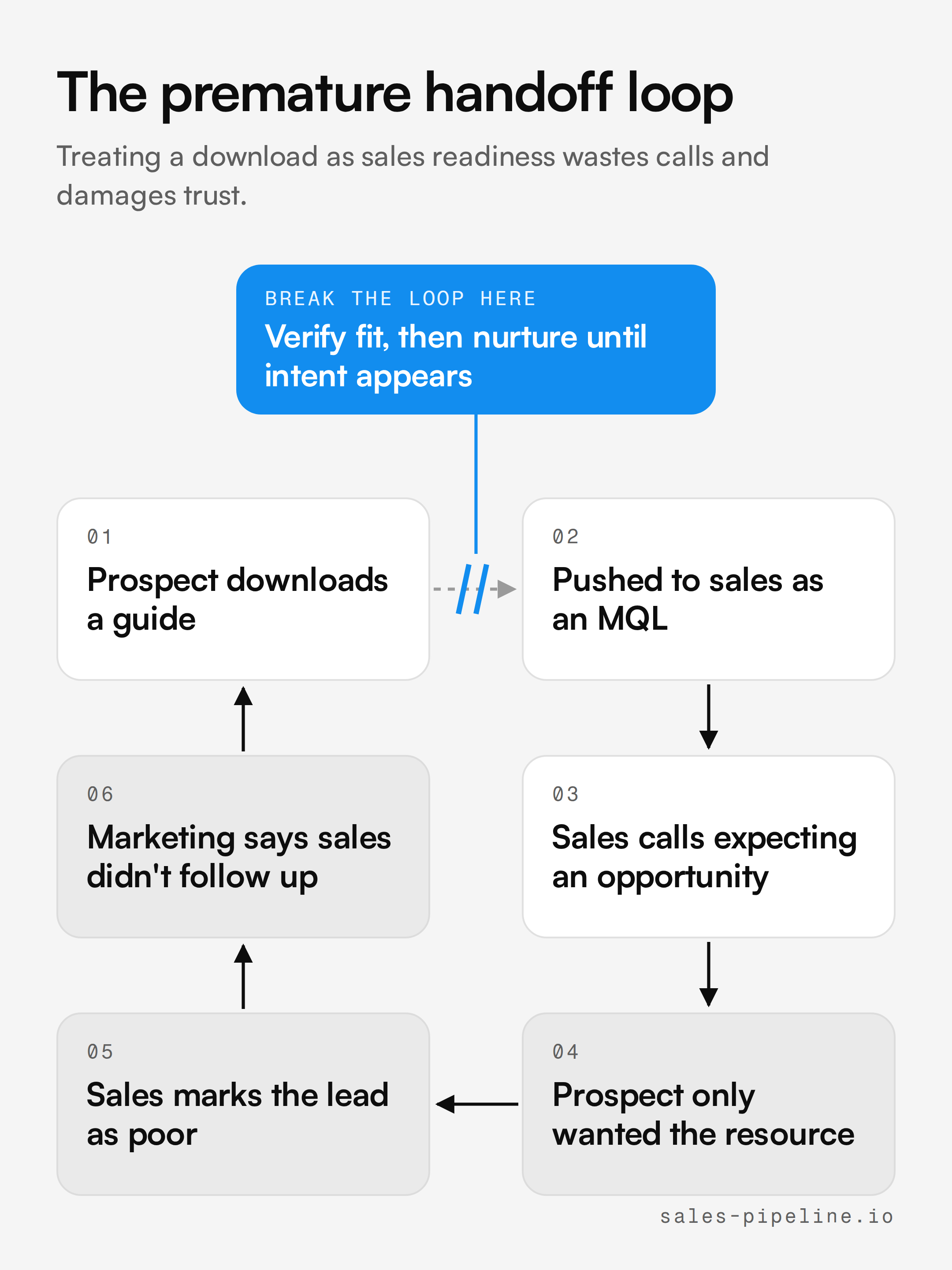
A prospect downloads a guide, checklist or template.
Marketing pushes the contact directly to sales, often under an MQL label.
Sales calls expecting a qualified opportunity but reaches someone who only wanted the resource.
The contact is confused, sales marks the lead as poor and marketing concludes that sales did not follow up properly.
The lead may not be bad. The timing is bad. Content engagement shows interest in a topic; it does not automatically show readiness to evaluate a solution, involve other stakeholders or take a sales meeting.
Before a lead-magnet contact reaches sales, marketing can verify basic fit and continue nurturing until a stronger signal appears. That signal might be a request to speak, repeated engagement with solution-oriented content, interest in pricing or another action both teams have agreed is meaningful.
MQL vs SQL vs Opportunity
Companies use lifecycle labels differently, so the labels are less important than the entry and exit rules. A practical model separates audience fit, problem interest and readiness for a sales conversation.
Stage | What is known | Typical next action | What should not happen |
Lead | A person or account is known, but fit and intent may still be unclear | Enrich, validate consent and identify relevant context | Assume every new contact deserves a sales call |
Marketing qualified lead | The contact fits the audience and has shown meaningful interest under marketing’s agreed rules | Nurture, verify fit and watch for stronger buying signals | Present content interest as a qualified opportunity |
Sales qualified lead | Sales accepts the lead because fit and buying intent meet the handoff standard | Begin a timely, relevant sales conversation | Route without the evidence that triggered acceptance |
Opportunity | A real buying process has been confirmed, with a problem, plausible path to purchase and agreed next step | Manage the deal through the sales process | Create pipeline merely because an SQL was contacted |
An MQL is therefore not simply a weaker SQL, and an SQL is not automatically an opportunity. Each transition should represent new evidence and a clear operational decision. If the wider lifecycle is unclear, start by documenting how you build a B2B sales pipeline and define the entry and exit rule for every stage.
The Evidence Required Before Sales Accepts a Lead
There is no universal scoring threshold that makes a lead sales qualified. Build the definition from observable evidence that fits your sales motion. Most teams need a combination of the following.
Account fit
The company, use case or buyer matches the customers you can serve profitably. Relevant factors may include industry, company size, geography, technology, business model or minimum commercial scope.
Problem relevance
The lead has a problem connected to the outcome you deliver. A generic interest in a broad topic is weaker than evidence that the specific problem exists in their business.
Buying intent
The lead has done something that reasonably indicates evaluation, not just education. Examples include asking to speak, requesting a demo, returning to pricing or service pages, replying to a nurture message with a specific question or repeatedly engaging with solution-oriented content.
Access to the buying process
The contact can participate in, influence or introduce the buying process. This does not mean every SQL must be the final decision-maker. It means sales has a plausible route to the people and process required for a decision.
Timing and reason to act
There is a reason for the conversation now. A deadline, operational cost, growth target, failed current approach or active evaluation can create urgency. When timing is unknown, the lead may still deserve a discovery call, but the uncertainty should be visible.
Agreed next action
The handoff should lead to a defined action: call within an agreed service level, send a contextual response, schedule discovery or route to the correct owner. Qualification without an action standard creates delay and duplicate follow-up.
Not every field needs to be fully proven before the first conversation. The aim is not to interrogate prospects before sales can speak with them. The aim is to give sales enough evidence to justify the interruption and enough context to make the contact relevant.
Use a Fast Path for Direct Sales Requests
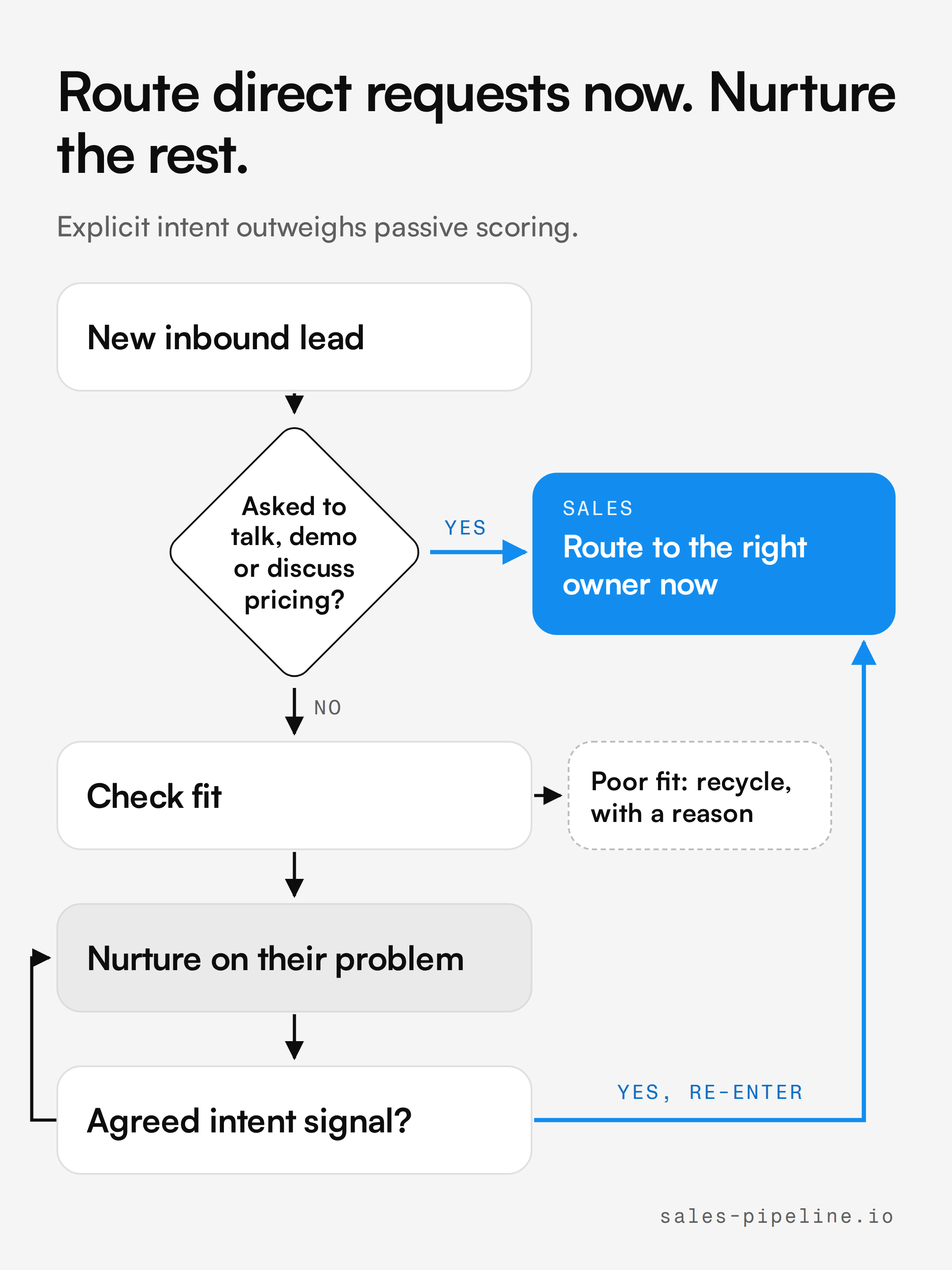
Do not let a qualification framework slow down someone who has clearly raised their hand. A demo request, a contact-sales form, a direct request to discuss the service or a reply asking for a meeting should route immediately to the right owner.
The team can still verify fit and prepare context in parallel. What it should not do is trap the buyer in a generic nurture sequence because their score has not accumulated enough points. Explicit intent should outweigh passive scoring.
Automated routing should preserve that judgement. The same principle applies wherever sales automation can damage buyer trust: use the system to accelerate a relevant response, not to force every buyer through the same sequence.

Build an MQL to SQL Acceptance Agreement
The cleanest handoff is an agreement between marketing and sales, not a score hidden inside the marketing platform. Write the criteria in plain language and test them against real leads.
Define the minimum fit requirements and the disqualifiers.
List the intent signals that justify sales attention and rank them by strength.
Separate explicit requests from inferred behaviour so direct requests receive the fast path.
Specify what context marketing must pass with the lead.
Give sales a clear accept, recycle or reject decision and require a reason.
Set the response time and ownership rule for each route.
Review accepted and rejected leads together until the definition is stable.
This agreement should include exit criteria as well as entry criteria. A rejected lead should not disappear into a closed-lost bucket without explanation. It may need correction, enrichment, a different owner or more time in nurture.
What to Do With Leads That Are Too Early
Too early is not the same as unqualified forever. Keep the contact in a nurture path that matches the problem they showed interest in, then look for progression rather than repeated low-intent activity.
Teach the next decision, not the same introductory idea again.
Use case studies, comparison content, implementation guidance and problem-specific offers to reveal evaluation behaviour.
Let prospects request a conversation from every relevant message and page.
Recycle sales-rejected leads with a clear reason and a defined re-entry trigger.
Stop treating email opens or one-off clicks as proof of buying intent.
A Practical Example
In one anonymized B2B engagement, lead-magnet contacts were being sent directly to sales. Calendars filled up, so representatives shortened calls simply to reach everyone. The process created more activity but less room for useful conversations.
The team changed the route: early-stage contacts were nurtured until they showed stronger intent, while direct requests kept a fast path. Sales received fewer meetings and had more time for each one. The lesson was not that fewer leads are always better. It was that sales capacity should be reserved for contacts who have earned a sales conversation, while marketing continues creating value for people who are not ready yet.
Measure Whether the Definition Works
Do not judge the definition only by the number of SQLs created. A tighter threshold can reduce lead volume while improving the quality and capacity of the sales process. Review the system with a small set of linked measures.
Measure | What it reveals | Useful cut |
MQL to SQL acceptance rate | Whether marketing and sales apply the same standard | By source, campaign and intent signal |
Speed to first response | Whether high-intent leads receive the promised fast path | Direct requests versus inferred-intent leads |
SQL to held conversation | Whether the timing and contact details are real | By owner and qualification route |
SQL to opportunity | Whether accepted leads enter a genuine buying process | By cohort, segment and trigger |
Opportunity to customer | Whether the definition produces commercially useful pipeline | By source and segment |
Recycle and rejection reasons | Why leads fail the handoff and what must change | Fit, timing, intent, data or routing |
Sales capacity | Whether representatives have enough time for preparation and quality conversations | Meetings per rep, call duration and follow-up completion |
Track cohorts rather than isolated weeks when buying cycles are long. Most importantly, review examples. A conversion rate can tell you that the definition is drifting; a shared review of accepted, rejected and recycled leads can show why.
Make those examples part of a regular sales pipeline review so stage definitions, rejection reasons and ownership problems are corrected while they are still visible.
Sales Qualified Lead Checklist
Use this as a starting worksheet, then replace the examples with evidence specific to your business.
Question | Evidence to capture | Required for your handoff |
Does the account fit? | Segment, geography, size, use case and disqualifiers | Yes, no or conditional |
Is the problem relevant? | Problem stated, inferred from behaviour or still unknown | Define the minimum |
What shows buying intent? | Direct request, pricing interest, repeated solution engagement or agreed trigger | Name the accepted signals |
Can this contact influence the process? | Role, team, access to stakeholders or path to the buyer | Define what is sufficient |
Why now? | Deadline, cost, target, active evaluation or unknown | Define whether unknown is acceptable |
What happens next? | Owner, response time, message and next step | Always required |
If sales declines it, where does it go? | Reject or recycle reason, nurture path and re-entry signal | Always required |
Protect Sales Time Without Losing Future Buyers
A sales qualified lead is not a person who crossed an arbitrary score. It is a lead that sales accepts because the evidence supports a timely sales conversation.
That means a lead-magnet download can start the journey without automatically starting a sales call. Verify fit, nurture for intent and preserve a fast path for people who ask to speak. Then use acceptance data and real lead reviews to keep the definition honest.
If your CRM contains plenty of leads but sales still cannot tell which ones deserve attention, SalesPipeline’s sales pipeline consulting can help you define the stages, handoff rules and reporting that turn activity into a workable revenue process.
Sign Up to Our Newsletter
Subscribe to receive updates and automation tips straight to your inbox.
Related Articles
AI automation insights to help your business move faster and smarter.

