Why Home Services Sales Reps Quit in Their First Year
Nov 10, 2026

Good home services reps rarely quit over the size of their pay. They quit because nobody set up their first 90 days. No training, a commission check that arrives months late with no warning, no coaching, and not enough leads to keep them busy. Most of it is fixable, and the fixes cost less than losing one rep.
A rep you liked asks for five minutes on a Friday. You already know how it ends.
The ones that hurt most are the decent reps who were two months from being good.
Most Reps Quit in the First 90 Days
A 2025 survey of 247 roofing companies, plus tracked activity from 340+ reps, put average yearly turnover at 78%, according to HailMate's roofing sales rep turnover analysis. The best-run quarter of companies held it to 41%. The worst were above 100%, meaning they lost more reps than they had seats. Median tenure was 9 months.
The leaving isn't spread across the year. It happens early. 18% of new hires were gone in 30 days. Another 26% left between day 31 and day 90. That's 44% of everyone hired, gone before the end of month three.
Roofing runs harsher than most trades because of storms and commission-only pay. Your numbers may be better. The pattern is worth checking in HVAC, plumbing, restoration, and remodeling.


Pay Timing Matters More Than Pay Size
SalesDraft, writing about roofing and solar sales teams, sees the same thing. Reps walk when the commission plan stops making sense. The split changes mid-quarter. The redline moves. Nobody explains it. Then the rep stops trusting the plan and starts taking recruiter calls.
What owners said caused the departure, from the roofing data:
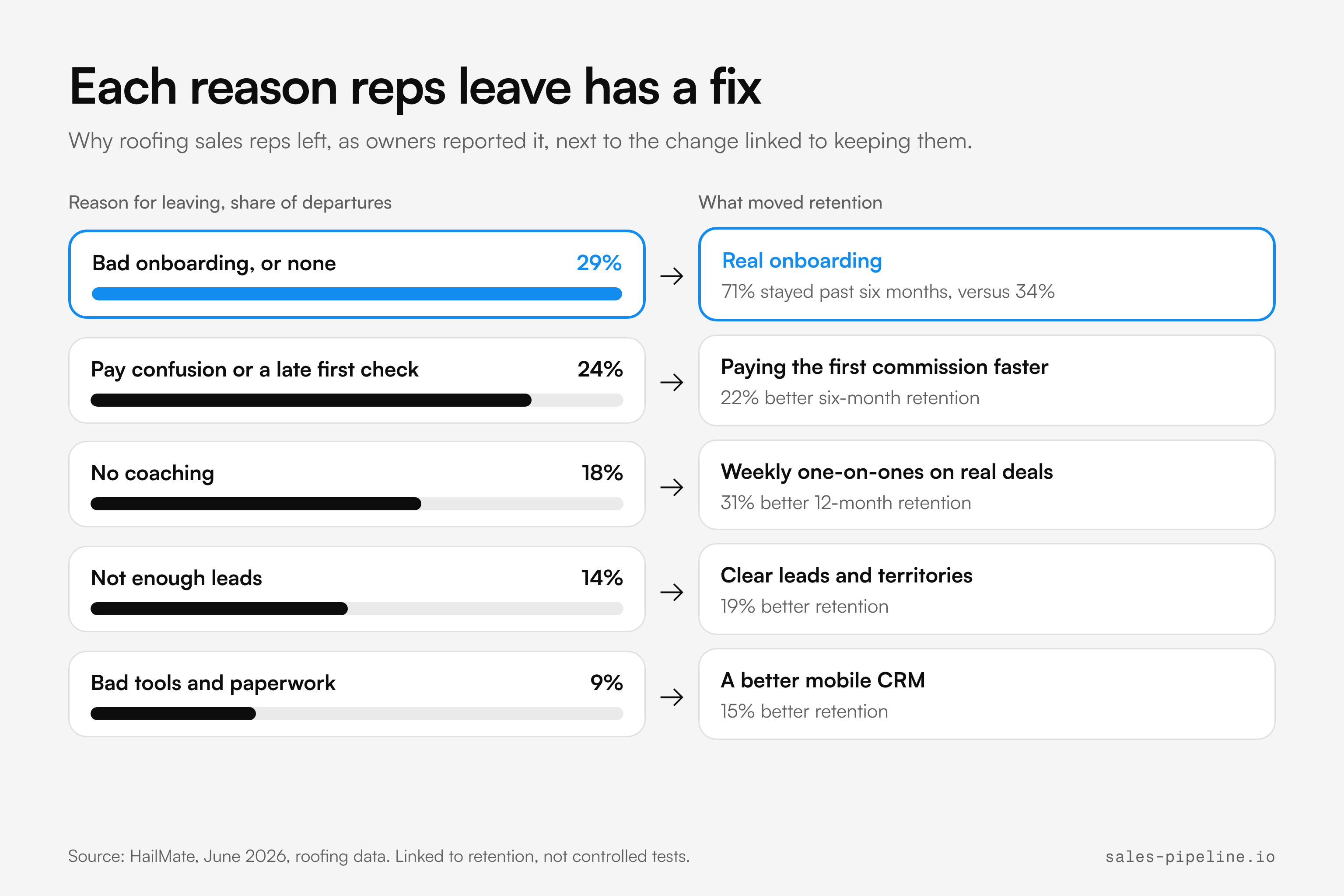
Bad onboarding, or none: 29%
Pay confusion or a long gap before the first check: 24%
No coaching: 18%
Not enough leads: 14%
Bad tools and paperwork: 9%
Everything else: 6%
The top two are 53% of departures, and both hit in the first three months. None of the named reasons is "we hired the wrong person." They're all things you can control.
Six Reasons Good Reps Leave
They get no training. A new rep needs to learn your product, your quote, and how your office runs. Most get a price book and a phone.
The first commission comes too late. A rep closes a job in week two and gets paid after the job is installed and paid for. Fine if you explained it on day one.
Nobody coaches them. They don't know if their close rate is normal, or if the appointment they just lost was winnable. Weekly one-on-ones on real deals were linked to 31% better 12-month retention. We've written separately about developing average sales performers through coaching.
They sit with nothing to work. A rep with no appointments can't sell. Clear lead and territory assignments were linked to 19% better retention.
Paperwork eats the day. Nobody got into this to type notes into a CRM. There's no admin support, no one dedicated to following up, and no real sequence, so every callback, cold quote, and unsold estimate depends on the rep remembering it on a busy day.
There's no year two. If the only way to earn more is to leave, good reps leave.
What Losing One Rep Costs You
Most owners count the recruiting fee. The real number is bigger. SalesDraft puts a lost seat at $15,000 to $20,000. Fully loaded, the roofing analysis says about $24,000, ranging from $8,000 for someone who quits in month one to $31,000 for a rep who leaves with deals in progress.
The biggest part is the deals that die when they walk. Quotes on their phone, homeowners who were deciding, appointments already booked. None of it transfers. It goes quiet.
Twelve reps at 78% turnover is nine departures a year, about $219,000. None of that shows up as a line on your P&L. For the wider cost picture, see the true cost of building a sales team in 2026.
What Keeps Reps Past the First Year
Same data set, ranked by what moved retention:
Real onboarding: 71% of reps stayed past six months, versus 34% of reps who were thrown in.
Weekly one-on-ones: 31% better 12-month retention.
Paying the first commission faster: 22% better 6-month retention.
Clear leads and territories: 19% better retention.
A better mobile CRM: 15% better retention.
These are associations in survey data, not controlled tests.
Start with onboarding. It doubles six-month survival, and you build it once.
If those twelve reps cut turnover from 78% to 50%, you lose about three fewer people a year. That's about $83,000.

What to Do in the First 90 Days
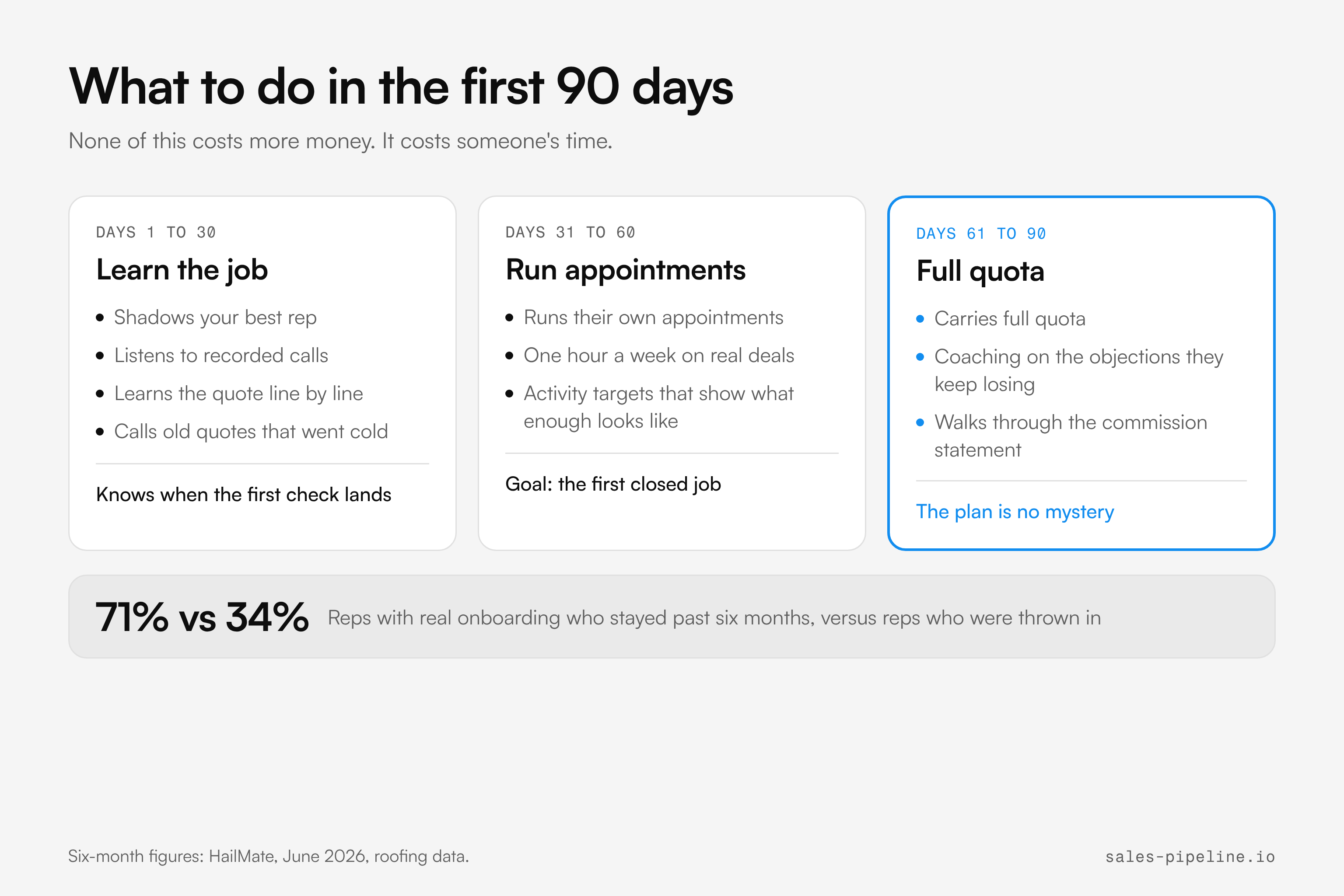
Days 1 to 30. The new rep shadows your best rep, listens to recorded calls, and learns the quote line by line. Their first real work can't hurt you: calling old quotes that already went cold. They know exactly when the first commission lands and how much it will be.
Days 31 to 60. They run appointments, and you review them. One hour a week on real deals, not a pipeline report. Activity targets show what enough looks like. The aim is the first closed job.
Days 61 to 90. Full quota. Coaching goes to the objections they keep losing, and someone walks through the commission statement with them so the plan isn't a mystery.
None of this costs more money. It costs someone's time.

How SalesPipeline Helps
New clients ask us the same question: how do we stop losing people?
Usually the retention problem and the ramp problem are the same problem. A rep closing jobs by week three has a reason to stay. A rep still guessing in month three starts answering recruiter messages.
On one home services account, ramp time went from more than 60 days to 14. Close rate went from 20% to 40%. Sales cost dropped 25%. The client had a record revenue month within 90 days.
What changed was the process the reps worked in, and a fractional sales leader reviewing their work every week.
If reps keep leaving before they get good, that's the gap we close for home services companies. Book a short call and we'll look at where your first 90 days are losing people.
Sign Up to Our Newsletter
Subscribe to receive updates and automation tips straight to your inbox.
Related Articles
AI automation insights to help your business move faster and smarter.

